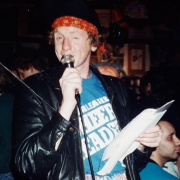
The Engine Room Pop Quiz: my small walk-on part at the outset of Britpop
It was just over thirty years ago that I first picked up a microphone with a view to entertaining an audience. We’re not talking stand-up comedy at this stage however. Instead, the context was that of a pop music quiz playing to around a dozen people in the then newly refurbished Engine Room pub, nestling on the Chalk Farm Road directly opposite legendary London gig venue, the Roundhouse.
The Engine Room had only been open a matter of weeks, having previously been a locals’ pub called the Belmont Inn. The pub had changed hands, and new gaffer Andrew James was intent on bringing in a more music-orientated – some might say – trendier Camden crowd. One of my best mates at the time who lived down the road from the pub and was there throughout the changeover – the recently departed and sadly missed Chris ‘Jack’ Wright – suggested that a pop quiz would be the very thing to enliven an otherwise quiet Tuesday night; reckoning, in the process, that he knew the very chap for the job.
If I’m honest, when the idea was suggested to me, I couldn’t get my head around it straight away. I’d heard of pub quizzes for sure, but the idea of a quiz devoted entirely to pop music seemed strange and new. Why would anyone want to go to that? Surely, if that was a prospect, it would exist in some shape or form already? Nevertheless, there was few quid being proffered, alongside the prospect of free drink, and so I thought ‘well, I’ll give it a go, see what happens; after all, what else am I likely to be doing on a Tuesday night?’ Doubts not so much dispelled, more bought off.
I didn’t have too much in the way of similar doubts however, when it came to the business of putting some questions together: I had an avid and longstanding appreciation of all things pop, rock and beyond; and for his part, Andrew was happy to chuck ideas for questions my way as well. But I did wonder if I’d be able to connect with the proposed Camden crowd given that – at the time – I was largely a soul and funk-orientated bass player and songwriter, and the Camden crowd seemed a bit more along the lines of indie alternative types. Such was the nature of youth tribal consciousness back then.
Despite the difference in dress codes, I did actually know all about the indie alternative band scene as a result of reading the NME every week; I just didn’t buy the music. At that time, the last really indie thing I’d purchased was ‘This Charming Man’ (excluding the odd Nick Cave covers album), and I tended towards the prejudicial opinion that indie music was overly middle-class, miserable-ist and largely devoid of anything resembling raunchiness. I read the NME for the quality of the writing contained therein, and loved the gleeful way in which the writers would disparage anything they saw as either inauthentic or kowtowing too much to the mainstream. I was also reading Smash Hits as well which, although it focussed primarily on the aforementioned mainstream, had a wonderfully irreverent way of undermining its subjects, largely – it seemed – with their co-operation. It’s fair to say, both publications ended up influencing the way I presented the various questions we put together.
I can’t say I remember too much about the first night, other than the fact that straight away, I felt very at ease in the role: engaging with the participants seemed to happen fairly effortlessly, with humour travelling in both directions. I also have an idea it was quite enjoyable but little else. In the space of a few short weeks however, the event started to attract more and more people, and steadily filled up. Somehow, with next to no publicity, we’d unwittingly become a regular fixture on the local scene.
As the night developed, it was obvious there were plenty of people attending who worked backstage when it came to the business of pop – marketing, publicity and the like – but typically, it was the various members of the then current groups that stick foremost in the memory… for obvious reasons really.
I remember a very early bunch of highly enthusiastic advocates that comprised something of an Irish cohort, led by a very affable gentleman called Nick Kelly, singer with The Fat Lady Sings. Alongside him, there was a quiet bloke who looked a bit like the Edge, and – lo and behold – turned out to be the Edge’s brother, Dik: more recently a member of the Virgin Prunes, and an original member of U2, before they became the phenomenon that is U2. It struck me as prudent not to mention the latter.
Another noticeable early attendee was Andy Ross of Food Records (invariably alongside the gloriously ebullient PR rep Polly Birkbeck) who I was already familiar with due to my tenure behind the bar at the Bull & Gate music venue in Kentish Town: Andy would turn up in his capacity as a Melody Maker journalist, presumably to review the bands. I was never quite sure how he succeeded in doing so, as he struck me as someone who had come along more for the party… but then I was in no position to judge as I was busy slinging it back at the same time; usually, on the basis that there were no end of willing punters proposing to keep my cup overflowing. Even when there weren’t willing punters proposing to do so, I pretended that there were, and drank anyway.
Andy and Polly were also in the habit of bringing along Dave Rowntree and – to a lesser extent – Graham Coxon, both of Blur of course. Blur had achieved a certain amount of success at this stage but iconic status was still a couple of albums away, and as a result, nobody paid them too much heed.
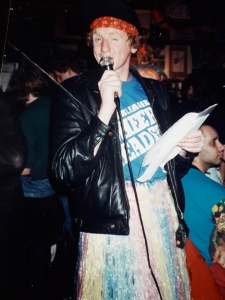
The theme for the evening? No idea, but clearly an alcohol-infused good time was being had
Of the two, Dave Rowntree struck me as a pretty relaxed, easy going sort of bloke; Graham Coxon however, seemed jittery and vulnerable, with a sense of humour that was indecipherable to all but his self. We’d developed a lyric round by this stage which we bolstered with extra points for karaoke renditions, and I remember having to wrestle the microphone off him on more than one occasion, as he made vain attempts to amuse the assembled throng. A brilliant guitarist, but you couldn’t imagine said vulnerability and the accompanying offbeat humour standing him in good stead down the largely working class environs of a dog track?
Other regulars included a team made up of original member of the Bromley Contingent Michelle Brigandage, Louise from the Wag, and Mary Byker: all of whom brought a genuine party atmosphere to the proceedings. One of the things they contributed was an array of sound effects in relation to the various categories of question, which subsequently assumed the status of catchphrases: the whole pub singing the theme to the Twilight Zone as a response to the regular question, ‘Spooky Pop Coincidences’ is one such instance permanently grafted onto the memory.
Then there was the likes of: Joe Dilworth, Melody Maker photographer and drummer with Stereolab (a band whose brilliance came to me a bit later than most); Chris Acland, drummer with Lush, a lovely fella who left this world too soon; NME journalist Terry Staunton, another keen karaoke participant; the Rockingbirds (I think it was they); and – arguably – encapsulating the mood of the whole event, clown princes for the evening, Matthew and Nigel out of Dodgy. I’ve still got the 12’’ promo of the lost classic ‘Water under the Bridge’ that they brought along one time, a fabulous song predating their later success.
And so it was that amidst all of these faces, I unwittingly became the host of a great big trendy party every week; having a complete blast in the process. Despite that, there were occasions when I didn’t know who some of the faces belonged to, even though others clearly did. One time, I remember Polly from Food being very enamoured of the fact a gentleman from a sketch called ‘History Today’ was in – the good looking one, apparently – but I had no clue. Another time, it was brought to my attention that some fast rising hot shot by the name of Chris Evans had graced us with his presence, but as I hardly watched TV – apart from TOTP – nor listened to the radio, once again I had no clue… although I did recognise the bloke with him as being Ian Broudie out of the Lightning Seeds. Having said that, I was certain that it worked in my favour not knowing who people were, as I ended up treating them in the same irreverent way as everybody else; I’m only aware of Mr Evans having ever put in one appearance, so it might be possible to suggest an equal and opposite argument to the ‘irreverent’ approach as well.
After the quiz, and being suitably charged up, I’d be looking for somewhere to head off to, to continue the revelry. One frequent option was to continue in the direction of the Camden Palace, given that I had the good fortune to live across the road from Jake Shillingford of My Life Story, who worked the door there on Tuesday nights and was kind enough to let me in for free. My Life Story was another outfit that emerged to a larger extent later on, seemingly filling the missing link between Pulp and the Divine Comedy.
At the Palace, things would get a little hazy, although I can vaguely remember certain bands being on the main stage such as Therapy and er… that’s it. I do remember one time, being introduced to Bernard Butler, just as Suede were becoming big news, and in a totally flat-footed over-garrulous drunken northern way, attempting to be humorous with him; only to watch him recoil in horror, and make a rapid exit. Looking back, it could seem as though I lacked a certain capability when it came creating a rapport with soon-to-be legendary Brit Pop guitarists, and had I thought about it at the time, maybe I should have tracked down Noel Gallagher, in order to validate the theory, in its entirety.
At other times, after the quiz was done – and frequently after the Camden Palace had chucked out as well – a bunch of us would inevitably wind up in the Marathon, an iniquitous Kebab and drinking hole situated at the end of Chalk Farm Road that catered for a mixture of nocturnal groovy types, insomniac outsiders, and members of the criminal fraternity; some of the latter exuded genuine menace, and although I saw a few fights in there, I never witnessed an actual stabbing, which various acquaintances would allude to, from time to time.
Once again, it’s all a bit of a haze, but a memorable moment occurred one night when Nick Cave and his entourage marched in, and upon entering, the big fella immediately nodded in my direction. I’ve no idea what that implied but I have to say – for me – it was probably the highlight of the whole period: I mean, just being on nodding terms with Nick Cave at the time, was worth a whole load of ‘being on conversational terms’ with what I thought to be lesser ranked alternate stars. Such is the folly of course, of seeing one’s self as part of any trendy scene: status and the perception of one’s own versus that of others is a constant source of neurosis, and – ultimately – a pointless waste of psychic energy.
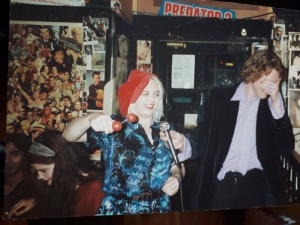
ACAB on the knuckles, and clackers being ably demonstrated on the occasion of a 70s-themed night
As the quiz developed, Andrew and I started to look at ways of keeping the crowd interested: one of which was to introduce themed nights, and invite the audience to come dressed up for the occasion. Other than a 70s night, when I had ACAB scrawled on my knuckles, once again, it’s all a bit hazy. I remember the ACAB thing not sitting too well with an otherwise decent bloke who had a familial connection to the police but I thought the gesture was OK on the grounds of authenticity: it was a pretty ubiquitous tattooed acronym throughout the course of my own early childhood, with some fellas being only too willing to give you a close-up when it came to the business of sticking their fist in your face.
I must have had some sort of an obsession with the 70s at the time – as indeed did many of the retro-regarding participants – because we also started doing a thing called ‘The Antiques Roadshow goes to Milton Keynes’ whereby we would give away 70s classics such as a pair of clackers or a Brush-o-Matic as prizes, as well as other K-Tel-like artefacts such as 20 Dynamic Hits… all to the tune of Bach’s Brandenburg Concerto No. 3. I’m not sure everyone was as into the prize-giving idea as me, as they would frequently be left behind or re-gifted back to us; not a problem as we could just give them out again at some point further down the line.
At the quiz’s height we were invited to do a couple of charity events. The first of which took place at a restaurant on the other side of the road, and – apparently – saw Clare Grogan in attendance; I must admit I was at a loss to be able to identify her. The other was put together by Food Records, and took place in the Engine Room, with what seemed like the whole of indie-dom turning up for the occasion: Blur in their entirety, Bobby Gillespie, Lush, Miles Hunt, as well as the likes of Janice Long and Johnnie Walker. There were probably others, of course… once again, a combination of alcohol and indifference to most of what constituted indie serving to erase the memory.
That said, neither event struck me as being particularly great fun. They weren’t in the same spirit as the usual Tuesday nights, playing to the regulars who really ‘got it’ and wanted to be there; rather than a bunch of medium profile characters ‘ligging’ their way to the next industry do, and for the most part, standing around and looking at each other. You see the same thing with bands that never so much as get a whiff of attention from the media, be it mainstream or otherwise, and yet cultivate a good following based upon an authentic appreciation on the part of the people who come along on a regular basis; arguably, more so nowadays, with the proliferation of social media and what have you.
One of the upshots of doing the quiz every week was that people were beginning to suggest that I should try my hand at stand-up. Reason being, I was making a lot of off-the-cuff remarks, and generating laughs; as well, of course, as the laughs that were engineered (no pun) into the questions. One particularly off-the-cuff remark that I was reminded of repeatedly, occurred one time when a person of shorter stature walked into the pub directly behind where I was standing (when the polite thing would have been to come in via the other door)… a person of shorter stature wearing a red duffle coat, on a night when ‘Don’t Look Now’ was on the TV later on; it was just a case of joining the dots, but the speed of the response had seemingly left the participants breathless, as there was a palpable gap between the delivery of the remark, and the point at which it dropped in the form of laughs of recognition.
At some point, about a year and a half in, I started to feel that we were running out of ideas, with numbers starting to wobble slightly in the process. So with a highfalutin notion – inspired by the likes of David Bowie and Fawlty Towers – I decided it was best to quit whilst we were seemingly on top. I’d been having a great time, and didn’t want to appear to be trying too hard. Without further ado, we stuck together an idea on the theme of death (no shortage of material in the rock and pop music world of course), and invited a stack of people down to do for a last hurrah. Fortunately for me, Terry Staunton brought his editor Steve Sutherland along to check me out as a prospect for the NME’s inaugural nationwide student Pop Quiz tour.
Conveying only a moderate level of approval, Steve gave me the go-ahead, and so, within a short period of ending the Engine Room Quiz, I was heading over to the NME’s offices, helping to format their quiz, and preparing to head out on the road to host half of the nights; with Terry in his capacity as co-conspirator doing the rest.
Somewhere in the midst of this post-Engine Room activity, I managed to audition for ‘The Word’ (a roving-reporter type-thing, I think) on the basis of someone else’s recommendation… I can’t remember who it was put me forward. I did watch the Word now and again – early return from the pub permitting – but it wasn’t something I coveted particularly. Despite feeling awkward, I feigned an upbeat enthusiasm during the audition; an upbeat enthusiasm that wasn’t really my strong suit. I didn’t get a call back, and was relieved. Coincidentally, I’d also seen Mark Lamarr down the quiz at one time or another; bearing in mind, that he eventually went on to present ‘Never Mind the Buzzcocks’. Was there a connection? If there was, I barely gave it a thought.
The NME tour immediately provided me with an insight that would be useful when it came to the business of doing stand-up on a more frequent basis: there is a huge difference between playing to a partisan crowd who’ve come to see you, compared to a load of people who have no idea who you are. Some nights were better than others, with my own seemingly laconic approach contrasting well with Terry’s channelling of the physicality of Denis Leary, to whom he bore a resemblance (at the time, Leary was a mock-angry non-PC Bostonian whose acting would ultimately eclipse his stand-up, due to a total loss of credibility amidst accusations of lifting Bill Hicks’ act in its entirety).
If either Terry or I struggled though, it was nothing compared to the indifference with which Aussie guest star, comedian and entertainer Bob Downe was being met, on most of the nights. We at least could masquerade behind our quiz questions, whereas Bob having been billed as a comic turn had little to hide behind, barring a crimplene safari suit and a blond wig. As a result, he wasn’t being terribly jovial off stage which – assuming this was down to the way his performances were being received – was all very understandable, I guess. Then again, maybe he was an archetype ‘unhappy offstage’ funny-type person? Who Knows?
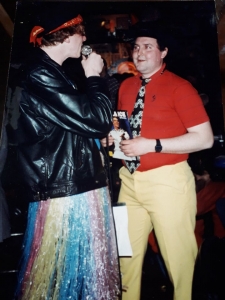
Andrew James, Engine Room proprietor and quiz collaborator
To be fair, it wouldn’t be long before I was getting my own taste of rejection via the medium of stand-up comedy as well. Having finally taken the advice of so many of the people who came to the Quiz, I took the plunge and booked myself into a load of open spots on the London Comedy Circuit. Like any other stand-up comic, I can still remember my very first gig: I got a big laugh for my opening gag, and was so surprised I lost it from thereon in. After that, my performances met with varying degrees of success, from intermittently funny to outright death, before having a straight-thru, laughs from start-to-finish time of it, somewhere around my seventh gig. I was elated, the bug had bitten, and even though I wouldn’t turn fully pro until the mid-noughties, I felt as though I’d found something that satisfied an existing need to do something creative, but with added autonomy; an obvious bonus if you’ve ever tried working with musicians?
Even though it was obvious to me, I could do stand-up, I should still have had a word with myself at this stage, because I was by no means a consistent performer; none of which stopped me from inviting Dodgy along to come and see me at Bunjies, a splendidly atmospheric little folk room with a huge history, situated just off of the Charing Cross Road. Predictably, I flat lined: total embarrassment from start to finish. There is nothing quite like experiencing comedy-death in front of people you know, to warrant an immediate questioning of one’s sanity both on the part of yourself, and that of your associates. I can’t remember the aftermath precisely – we may have ended up in a cab together at the end of the night – but that was the last I saw of the chaps in Dodgy. They continued on a trajectory towards greater recognition, and I went home to question my own existence.
I carried on of course, but I pretty much lost touch with the business of performing as a musician in the process. Like I say, the feeling of autonomy was very attractive, but it was also down to the fact that I’d succeeded in killing off a part of the passion for music, via the means of the ironic detachment I had employed week in, and week out at the Quiz: an ironic detachment that – in a wider sense – was going to inform the culture to an even greater extent throughout the rest of the decade. Obviously, I can’t claim to have pre-empted that, but there was clearly something going on at the outset of the 90s, that involved looking back, in order to move forward.
If there was an element of it being a partial last hurrah for me music-wise, the bigger picture looks even more like that, from a distance of twenty plus years. The 90s now look like the final fling for a certain type of hedonistic rock’n’roll sensibility whereby all the young dudes carried the news, prior to the internet coming along and changing everything via the means of – amongst many other things – an intense and immediate form of scrutiny that serves to highlight any forms of bad behaviour. I mean, how else would you even start to explain the business of a group of clean-cut choirboys like Coldplay becoming the biggest band in the world?
Anyway, sometime between packing the quiz in, and giving stand-up comedy a go, I bumped into Andy Ross near to Camden Town tube station – probably, talking late ’93, early ’94 here – and in the midst of a quick catch-up, he asked me if I’d like to come along to Food Records and give Blur’s latest single a listening to. Naturally, I assented.
I’d been along to Food before (at the time of the charity gig, I think), and as on that previous occasion, I found the prospect of hanging out at a record company office quite appealing: you never know who you might get to see in there. In this instance, the first person I got to see in there was David Balfe, one time member of Teardrop Explodes, Andy’s business partner at Food, and – ultimately the subject of Blur’s ‘Country House’. Balfie was entertaining Goldie, along with the most intimidating and ferocious looking dog I think I’d ever clapped eyes upon. Somehow, I still managed to find Goldie a more imposing prospect.
Having met Balfie before at the charity gig, I’d got the impression that he regarded me as a bit of a dick, and the look of mild condescension I picked up from him, upon arriving at Food on this particular occasion, did nothing to dispel that initial suspicion. Keen to give me a swerve, he ushered Goldie into another room, whilst I made my way with Andy, to hear Blur’s latest offering. If I’m honest, I can’t say I was particularly bothered by Balfie’s reaction. As I’ve said previously, I was an avid reader of all things NME and I’d read enough Julian Cope interviews to convince myself that if I’d failed to ingratiate myself with him then I was in good company. Saint Julian versus a patronising disregard from Balfie? At the time, no contest from my perspective.
Having gotten myself comfortable in Andy’s office, I prepared to cast my vote on the upcoming Blur offering. I have to admit, I didn’t know what to expect, particularly in the light of having heard previous Blur material and been largely indifferent. Added to which, I’d been working in a studio alongside Damon not long prior to this pre-release listen (on my own stuff alongside another much missed great pal and musical collaborator Dece Gambe), and from the little I could hear, I hadn’t developed cause to alter my stance. The only thing I could remember relating back to that particular occasion, was the business of Damon sending his engineer into the room we were working in, to see if we had anything by way of combustibles he could scrounge.
So ever-present indifference at the ready, you can envisage my total wrong footing when I was hit full-on with the keys, drum machine and – most significantly for me – loopy upfront bass stylings that constitutes ‘Girls and Boys’. I was genuinely enthralled and said as much, remarking upon how the bass sound reminded me of Duran Duran (coincidentally, the same way Alex James is on record as describing it as well). That aside, it was difficult to classify, but nonetheless, I was really pleased to be able to say how much I liked it.
Admittedly, it would also have been great to be able to say that I’d issued forth with something along the lines of ‘I reckon this single represents the first critical sighting of a new cultural epoch that will ultimately come to be known as Britpop which, in turn, will come to be the defining movement of the 1990s (progressive sounds in dance music notwithstanding): the point at which previously perceived left-of-centre indie bands will move into the mainstream, everybody has a massive party, and we all get to make a hugely ironic nod to the nation’s heritage whilst simultaneously detaching ourselves from the more unfortunate tendencies that come with the accompanying historical baggage’.
But I didn’t say that obviously… I just made remarks to the effect that acknowledged the song’s potential for greatness, and undoubtedly headed back out into the cold Camden air, pre-occupied both with a forthcoming stand-up gig, and the business of working out the whereabouts of the next short term thrill… the Pop Quiz now long behind me.